The landscape of biological research has shifted. We no longer just "do" biology; we compute it. As we move through 2026, the intersection of Generative AI and genomic sequencing has turned bioinformatics from a niche laboratory support role into the primary engine of drug discovery.
If you are a professional who "speaks" both Python and Protein, you are currently holding one of the most valuable skill sets in the modern economy. But what is that skill set actually worth in today’s market?
In this guide, we break down the average salary range for bioinformatics in the US, exploring how experience, education, and the "AI premium" are driving compensation to record highs.
1. The 2026 Bioinformatics Outlook: An Industry Overview
Bioinformatics is no longer just about managing databases. In 2026, the field is dominated by Multi-omics integration and AI-driven therapeutic design. According to recent labor statistics, demand for computational biologists and bioinformatics scientists has grown by 18% over the last two years, significantly outpacing traditional lab-based roles.
Key Trends Driving Salaries:
- The Generative AI Boom: Companies are aggressively hiring professionals who can use Large Language Models (LLMs) to predict protein structures or automate gene-editing workflows.
- Decentralized Clinical Trials: The rise of remote monitoring has created a massive need for bioinformaticians who can handle disparate, real-world data at scale.
- Personalized Medicine: As "N-of-1" therapies become more common, the ability to analyze individual patient genomes in real-time has moved from academic theory to high-paying commercial reality.
2. Average Salary Range for Bioinformatics in the US
The current national average salary for a Bioinformatics Scientist in the US ranges from $118,000 to $135,000 per year. However, "average" rarely tells the whole story. Total compensation (TC) often includes sign-on bonuses, annual performance bonuses (typically 10–20%), and Restricted Stock Units (RSUs), which can push the package significantly higher. Compare how this range differs based on industry, job titles, and experience levels with our Interactive Bioinformatics Salary Comparison Chart.
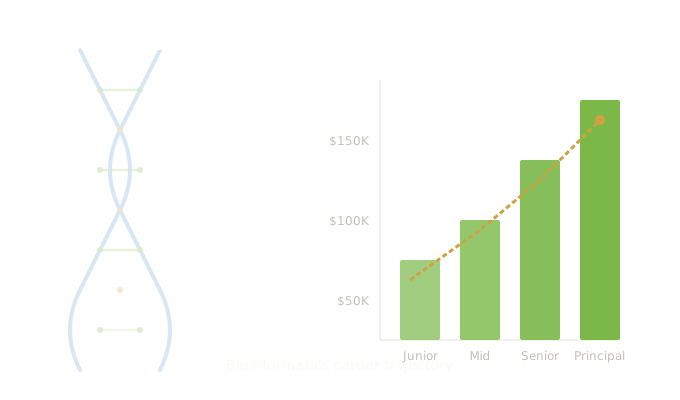
Salary Breakdown by Experience Level
| Experience Level |
Years of Experience |
Estimated Base Salary Range |
| Entry-Level |
0–2 Years |
$78,000 – $108,000 |
| Mid-Level |
3–6 Years |
$115,000 – $158,000 |
| Senior / Principal |
7–10+ Years |
$165,000 – $245,000+ |
| Bioinformatics Director |
12+ Years |
$220,000 – $350,000+ |
Pro Tip: In 2026, the "Entry-Level" ceiling has been shattered by candidates with specific expertise in Cloud Architecture (AWS/GCP). If you can build the pipeline and analyze the data, expect to start at the higher end of the bracket.
| Experience Level |
On-Site (Tier 1 Hubs*) |
Fully Remote (US) |
Avg. "Hub Premium" |
| Entry-Level |
$95,000 – $118,000 |
$82,000 – $98,000 |
+14% |
| Mid-Level |
$142,000 – $168,000 |
$125,000 – $145,000 |
+12% |
| Senior Scientist |
$185,000 – $230,000 |
$160,000 – $195,000 |
+15% |
| Director Level |
$250,000 – $340,000+ |
$215,000 – $280,000 |
+18% |
*Tier 1 Hubs include San Francisco Bay Area, Boston/Cambridge, and San Diego.
2026 Salary Trends Note:
- The "Remote Floor": In 2026, fully remote roles are no longer paying "local rates." Instead, top-tier biotech firms have established a national floor to prevent talent poaching from California-based competitors.
- The Office Bonus: The 12–18% premium for on-site roles is often marketed as a "Location-Based Adjustment" or "Commuter Subsidy" in job descriptions to encourage laboratory-adjacent collaboration.
- Equity Equity: Interestingly, equity (RSUs) is the great equalizer. While base salaries are lower for remote workers, high-growth startups often offer the same equity package regardless of location to ensure all employees are equally invested in the company's success.
3. Geographic Hubs: Where the Money Is
While remote work remains a staple of the industry, "Bio-Hubs" still command the highest premiums due to the concentration of VC-funded startups and Big Pharma headquarters.
The "Big Three" Hubs
- Boston / Cambridge, MA: The undisputed capital. Average salaries here are 15% above the national average, though the cost of living is equally steep.
- San Francisco / Bay Area, CA: Home to the "Tech-Bio" revolution. Here, equity packages are often more aggressive than base salaries.
- San Diego, CA: A massive cluster for genomics (Illumina's backyard), offering a high quality of life with competitive six-figure salaries.
The Emerging 2026 "Value" Hubs
If you’re looking for a better salary-to-cost-of-living ratio, keep an eye on:
- Research Triangle Park, NC: Massive growth in agricultural bioinformatics and clinical data roles.
- Seattle, WA: The fusion of Microsoft/Amazon tech talent with the Fred Hutch cancer research ecosystem.
- Austin, TX: Rapidly becoming a secondary hub for computational biology startups fleeing high California taxes.
4. How to Qualify for the Top Salary Tier
To reach the $150k+ milestone, your resume needs to reflect more than just a passing familiarity with BLAST or ClustalW.
Education: The Degree Ceiling
The "PhD requirement" is softening, but it still dictates your starting point:
- Bachelor’s Degree: Usually limited to "Bioinformatics Technician" or "Junior Analyst" roles. Salary ceiling: ~$100k.
- Master’s Degree: The "Sweet Spot." Most 2026 roles in industry accept a Master’s plus 3 years of experience in lieu of a PhD. Salary range: $120k – $160k.
- PhD: Still the gold standard for "Scientist" titles and R&D leadership. Mandatory for roles involving novel algorithm development. Salary range: $140k – $250k+.
The "Money" Skills for 2026
If you want to negotiate from a position of power, ensure your toolkit includes:
- Coding: Python (Expert), R (Tidyverse/Bioconductor), and C++.
- AI/ML: PyTorch or TensorFlow for biological sequence modeling.
- Data Engineering: Nextflow, Snakemake, and Docker/Kubernetes.
- Cloud: Professional certification in AWS Biotech or Google Cloud Life Sciences.
5. Top Companies Hiring Bioinformatics Professionals
The employers in this space generally fall into three categories, each with different compensation philosophies:
1. Big Pharma (The Gold Standard for Benefits)
- Examples: Pfizer, Novartis, Merck, AstraZeneca.
- Perks: Exceptional job stability, high base salaries, and robust 401k matching.
2. Genomics & Tooling (The Industry Giants)
- Examples: Illumina, 10x Genomics, PacBio.
- Perks: Employee Stock Purchase Plans (ESPPs) and the chance to work on the hardware that generates the world's data.
3. "Tech-Bio" Startups (The High Upside)
- Examples: Recursion Pharmaceuticals, Freenome, or companies focused on AlphaFold applications.
- Perks: High-risk, high-reward equity packages. This is where you go to potentially become a "Bio-Millionaire" via IPO.
6. How to Apply and Negotiate in 2026
When you're ready to make a move, don't just "apply." Position yourself as a solution to a data bottleneck.
- Optimize Your GitHub: For bioinformatics, your code is your credential. Ensure you have documented pipelines available for review.
- Negotiate Beyond Base: In 2026, "Compute Stipends" or "Remote Hardware Budgets" are common. If the base salary is firm, ask for a one-time sign-on bonus or additional RSU grants.
- Find Your Next Role: Looking for a curated list of high-paying opportunities?
7. FAQ Section
Q: Is bioinformatics a high-paying career compared to Software Engineering?
A: While entry-level Software Engineers at "Big Tech" might start higher, Senior Bioinformatics Scientists often parity with Senior SWEs, especially when you factor in the high demand for domain-specific knowledge in biology that generalist coders lack.
Q: Do I need to be a citizen to get high-paying bioinformatics jobs in the US?
A: Many biotech firms in hubs like Boston and San Francisco are highly supportive of H1-B and O-1 visas for specialized computational talent, as the "talent war" for bioinformaticians remains intense in 2026.
Q: What is the highest paying sub-field in bioinformatics?
A: Currently, Structural Bioinformatics (Protein Folding/AI) and Clinical Oncology Bioinformatics command the highest premiums due to their direct link to high-revenue drug pipelines.
Q: Are remote bioinformatics jobs still common in 2026?
A: Yes. Roughly 40% of bioinformatics roles are now "Remote-First," though "Hybrid" roles in major hubs typically offer a 5–10% salary premium over fully remote positions.
Final Thought
The average salary range for bioinformatics in the US is reflective of a field that has become the backbone of modern medicine. Whether you are an entry-level analyst or a seasoned PhD, your ability to extract meaning from biological noise is more valuable than ever.